War in Iran, a possible regime collapse in Cuba, and Democratic protests against both, are the talk of the country. But no one is talking about four constitutional amendments in Virginia. Early voting has already started on one of them – the Virginia Redistricting Amendment. National Republicans ignore the Virginia redistricting fight at their own peril. And “low-propensity” Virginia voters sit this special election out at their own peril – and that of all other Virginians.
The Virginia Redistricting Amendment
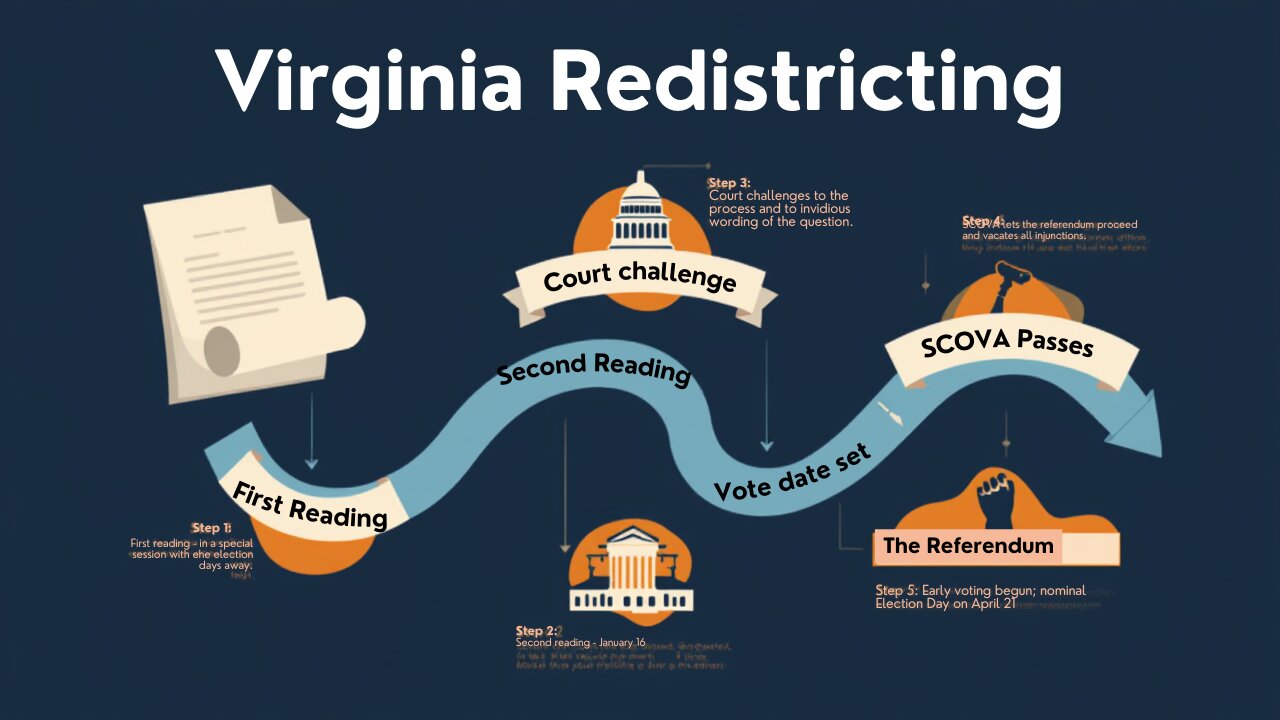
The Virginia Redistricting Amendment is one of four the Democrat-controlled General Assembly allegedly passed on:
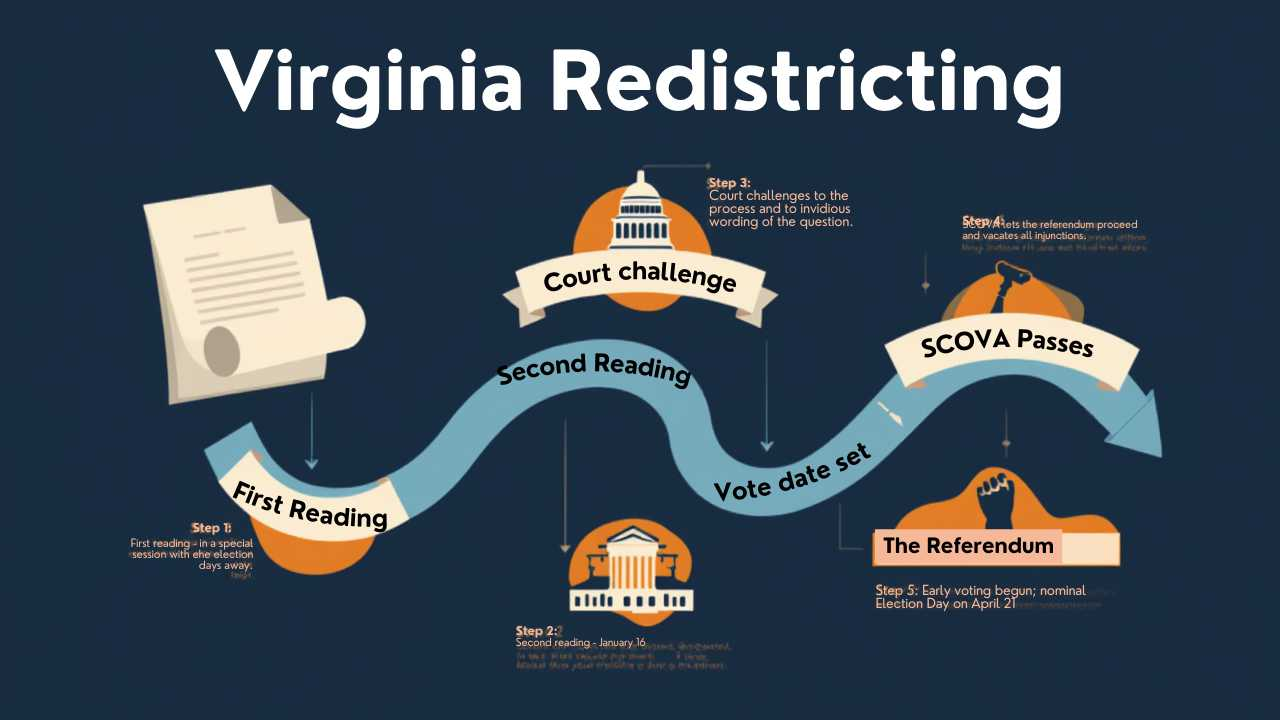
First reading a scant four days before Election Day 2025, and
Second reading on January 16, 2026, shortly after a new House of Delegates swore itself in. (This also took place under a new Governor, Democrat Abigail Spanberger.)
The text of the public question for this amendment reads:
Should the Constitution of Virginia be amended to allow the General Assembly to temporarily adopt new congressional districts to restore fairness in the upcoming elections, while ensuring Virginia's standard redistricting process resumes for all future redistricting after the 2030 census?
The official explanation of the text reads in relevant part:
The proposed amendment would give the General Assembly the authority to redraw one or more of Virginia's congressional districts before 2031 in limited circumstances. In the event that another state redraws its own congressional districts before 2031, without being ordered by a court to do so, the General Assembly would then be able to redraw Virginia's congressional districts. The General Assembly's power to do so would continue until October 31, 2030, and the Virginia Redistricting Commission would reassume the responsibility of drawing the congressional districts in 2031.
The proposed district map has been approved by the General Assembly and would take effect only if the constitutional amendment is approved by the voters.
A "yes" vote would allow the General Assembly to redraw Virginia's congressional districts, since other states have done so, in addition to giving effect to the proposed district map in time for the 2026 Congressional elections, and return the responsibility of drawing the congressional districts in 2031 to the Virginia Redistricting Commission.
A "no" vote would leave the authority to draw congressional districts with the Virginia Redistricting Commission once a decade and Virginia's current districts would remain in place.
While the explanation, by all accounts, follows the effect of the proposed amendment, the text could mean anything. More to the point, the General Assembly could, if it sees fit, draw districts twice more before October 31, 2030.
Some history is in order. In 2021, Virginians passed another constitutional amendment creating an independent redistricting commission to draw U.S. congressional districts. That commission, with equal numbers of Democrats and Republicans, deadlocked. So the Supreme Court of Virginia (SCOVA) appointed two Special Masters to draw the maps Virginia uses today. For the most part, Virginia’s eleven districts are compact and almost all nearly convex. Virginia’s House delegation consists of six Democrats and five Republicans. Presidential candidates Joseph R. Biden (2020) and Kamala Harris (2024) carried Virginia by similar margins.
But the State of Texas, at least, redrew its Congressional map earlier this season. It operated on the theory that populations had shifted, and an earlier legislature had drawn unfair maps.
What the new Virginia map would look like
Ballotpedia has an article showing the present map and the new map that Sen. (and Senate President pro tempore) L. Louse Lucas (D-Portsmouth) introduced and saw through to passage. The Virginia Public Access Project (VPAP) features both maps, each copyright by OpenStreetMap.org. OpenStreetMap maintains this page to explain their copyright and Open Document Licensure.
https://news.ballotpedia.org/wp-content/uploads/2026/02/Screenshot-2026-02-18-112046-1024x528.png
https://news.ballotpedia.org/wp-content/uploads/2026/02/Screenshot-2026-02-18-112032-1024x516.png
Full interactive versions of these maps are available at these links: 2021 and 2026.
As one can readily see, the overall partisanship of the Virginia House delegation would change from 6-5 Democrat to 10-1 Democrat. This represents a four-seat pickup. More to the point, this second map concentrates all voting power in a handful of Democratic strongholds. They include Fairfax, Loudoun, and Prince William Counties, and the Cities of Richmond, Roanoke, and Norfolk.
Sen. Ted Cruz (R-Texas) reacted in anger on X:
https://x.com/tedcruz/status/2019835586178146587
Sen. Lucas obscenely retorted:
https://x.com/SenLouiseLucas/status/2019964970470109386
Another user promptly reminded Sen. Lucas about the shut-out of Republicans from Maine, New Hampshire, Vermont, Massachusetts, Connecticut, and Rhode Island.
https://x.com/Rust_And_Decay/status/2020067335172944361
Some doubt remains about whether the Democrats would successfully “flip the House” with this new map. The United States Supreme Court has yet to rule on Louisiana v. Callais (Docket 24-109) and Press Robinson v. Callais (24-110). Those cases challenge “majority-minority” districts and the alleged mandate for them under the Voting Rights Act. If the Court strikes down that VRA provision, Republicans could gain 19 seats right away.
But that wouldn’t restore certain rights Virginians would lose.
How Virginians would lose under this plan
The most important thing Virginia voters would lose under this plan, is any sense that their representatives represent them. Ten of them would represent the Democratic Party of Virginia and presumably the Democratic strongholds named above. Four of those proposed districts each contain a slice of Fairfax County – enough to control each district. So Representatives might as well site their offices all in Fairfax County. What representation do residents of Hanover, Goochland, Louisa, and Buckingham Counties, to name four, have? None.
Are residents of those counties, who vote Democratic, really that incensed at President Donald J. Trump and the Republicans? Would they really sacrifice the convenience of being able to visit or call a more local Congress Member’s office? What do residents of Hanover County have in common with residents of, say, Spotsylvania County and the City of Fredericksburg? Or with those of Fairfax County and the town of Falls Church?
More to the point, constituent service matters. Your local Member of Congress and his staff do more than field your telephone calls on upcoming legislation. They write letters of recommendation to support applications for admission to the country’s military service academies. They intercede on constituents’ behalf with various federal agencies, including – notoriously – the Social Security Administration. Sometimes they agree to meet with constituents. Well! How will that work out for South Central Virginians, if their offices are all in Northern Virginia?
How did Virginia get to this pass?
The reason we have a Virginia redistricting amendment to contend with, is that Virginia Republicans tend not to vote. They vote in federal and especially Presidential elections. But, except for the famous Virginia Pre-Midterm of 2021, they do not vote in Virginia-only elections. Observe the result! In November 2025, Virginia Democrats got the trifecta.
Worse, they campaigned as moderates – but are governing to the left of Gov. Gavin Newsom, D-Calif., and his fellow Democrats in that State’s legislature. Never mind their own Congressional redistricting vote. Look at the exorbitant taxes, the Alphabet Soup agenda, and their abortion and illegal immigrant sanctuary policies. Gov. Spanberger and her fellow Democrats in Richmond are rapidly emulating every part of the California Craze.
Of course, that California East Craziness ought to make people angry enough to vote to stop this agenda. Early voting, as mentioned above, began last Friday. Local “unit” Republican committees are going all-out to encourage people to vote No. That also includes southwestern Virginia, where Republicans will lose one of the two Representatives they now have in that region.
Fighting Virginia redistricting – in court
To be fair, more national Republicans than Ted Cruz are fighting this plan. But they are fighting it in court. Their legal theories include:
The General Assembly held the First Reading in a special session, and passed their bill with four days remaining before Election Day. Early voting had almost wrapped up by then.
The second reading happened January 16. By the relevant section of the Code of Virginia, early voting should not have started until after April 16. That would be April 17, with Election Day to fall on June 2.
A circuit judge in Tazewell County (in that southwestern Virginia region) has already found in favor of these points. But SCOVA said the referendum should proceed while litigation is taking place. SCOVA must think that the plaintiffs:
Will not suffer irreparable harm if the referendum continues, because the court can always set the vote aside, or:
Are not likely to prevail on the merits.
More likely, SCOVA plans to rule against all challenges and accept the result of the vote – however it turns out. If the vote is No, they will declare those challenges moot.
Meanwhile, the Democratic National Committee is pouring 20 million dollars into a Yes campaign. Their pleas, which one can read straight off their campaign signs, read thus:
Level the playing field!
MAGA is rigging elections!
Former President Barack Obama echoed that refrain:
https://x.com/BarackObama/status/2029542802615341068
And Republicans? Aside from the court challenges, they consider Virginia already lost.
Is Virginia lost?
The Virginia redistricting referendum gives Virginians one last chance to save their State from forever Democratic rule. (And this time, the Democrats do not have the relatively benign machine of Harry Flood Byrd to lead them!) If that referendum passes, residents of the present Sixth and Ninth Districts might as well start looking for houses in neighboring West Virginia and Kentucky and possibly Tennessee. (In fact, some activists are looking to encourage West Virginia to annex all or most counties in those districts Think “Greater West Virginia,” similar to “Greater Idaho.”) Residents further east will likewise think about moving.
Residents of California are already moving. The billionaires are moving beyond the jurisdiction of the new “wealth tax” (a tax on net worth, not merely income). But The Los Angeles Times has to admit that “regular people” are also leaving. The U-Haul Truck Finder shows today that it costs almost twice as much to move out of California as to move into it. All this is part of the larger Great Sortation into “red areas and blue areas.”
How not to lose the Virginia redistricting battle
If rural Virginians don’t want the Democrats to chase them out of Virginia, they must vote No on this referendum. Then they must hold the line – while having the children who will outvote the Democrats, if present birth trends continue. Then perhaps they can enact measures like:
A “SVVE” Act (Saving Virginian Voter Eligibility) to make sure only United States citizens vote in our elections – and only once, and
New rules for drawing legislative maps and electing governors, lieutenant governors, and Attorneys General.
To review:
Delegates would be apportioned among units (counties and independent cities) according to population. Each unit would get at least one Delegate, and units (usually cities) having too many people in them, would get two Delegates, or three. But under no circumstances would Delegate district boundaries cross county lines or city limits.
U.S. Congressional district lines would not cross county lines or city limits, either. Districts would be compact, contiguous, and convex (or nearly so).
Each unit would get one Senator, which that unit’s City Council or Board of Supervisors would choose.
Each unit would get as many Gubernatorial Electors as the number of Delegates and Senators they send to the General Assembly.
A tall order? Yes. It would also require challenging and striking down Reynolds v. Sims, 377 U.S. 533 (1964). That’s the “one person, one vote” precedent. So be it. “One person, one vote” got us to this present pass.
In sum
That’s for, one hopes, a future we can secure through local family-friendly policies. But the important thing Virginians should do now is: Vote No. The arguments by President Obama, Governor Spanberger, Senator Lucas, and others are worse than specious. Texas merely teased out five new seats in a delegation of more than fifty. Even that was likely a reversal of decades of shenanigans by Democrats when they controlled the Texas legislature. That’s not a good reason to deprive one’s neighbors of the convenience of being able to visit the local office of their local, and neighborly, Member of Congress.
Senator Lucas and Governor Spanberger forgot how Virginia organizes itself – its Commonwealth model in which counties stay separate from cities. President Obama wouldn’t know about things like that. Nor would he care. He made the national Democratic Party what it is today – a party of traitors and social wreckers. It ill befits a Virginian, high-ranking or low-, to make common cause with that sort of person.
It also ill befits a pastor or deacon to say, “We don’t talk politics in church.” No church should ever depend for its functioning on Democrat donors, anyway. One cannot be a Christian and a Democrat – not a Democrat like Barack Obama or Abigail Spanberger. (Or a Senator who uses unladylike language to reply to a United States Senator.)
In sum, it’s about time everyone talked to one’s neighbors, fellow church members, etc., about the issue that will decide what representation means. Vote No.
Link to:
The article:
https://cnav.news/2026/03/08/editorial/talk/virginia-redistricting-forgotten-theater/
Video:
Public question and explanation:
Source material about the old and new district maps:
https://www.openstreetmap.org/copyright
https://www.vpap.org/redistricting/plan/us-house-of-representatives/
https://www.vpap.org/redistricting/2026/
Dialogue on platform X:
https://x.com/tedcruz/status/2019835586178146587
https://x.com/SenLouiseLucas/status/2019964970470109386
https://x.com/Rust_And_Decay/status/2020067335172944361
https://x.com/BarackObama/status/2029542802615341068
Supreme Courtr dockets on the VRA consolidated cases:
https://www.supremecourt.gov/search.aspx?filename=/docket/docketfiles/html/public/24-109.html
https://www.supremecourt.gov/search.aspx?filename=/docket/docketfiles/html/public/24-110.html
Home page of Rep. Rob Wittman (R-Va.-1st) illustrating constituent services:
The U-Haul Truck Finder:
https://www.uhaul.com/Truck-Rentals/
Previous articles:
The Virginia Pre-Midterm of 2021:
https://cnav.news/2021/11/04/news/glenn-youngkin-virginia-sweep/
Great Sortation:
https://cnav.news/2025/02/01/accountability/executive/great-sortation-turn-violent/
Generational change:
https://cnav.news/2026/02/07/editorial/talk/generational-change-american-politics/
Model for drawing maps and electing governors:
https://cnav.news/2021/11/05/accountability/legislative/legislatures-model/
Reynolds v. Sims (1964):
https://cnav.news/2021/11/05/accountability/legislative/legislatures-model/
Declarations of Truth:
Declarations of Truth Locals Community:
https://declarationsoftruth.locals.com/
Conservative News and Views:
Clixnet Media